
What Is RAM? How Much Memory You Actually Need in 2026
RAM vs storage, DDR4 vs DDR5, and the 2026 amounts that actually matter — 8GB or 12GB on a phone, 16GB or 32GB on a laptop, in plain English.

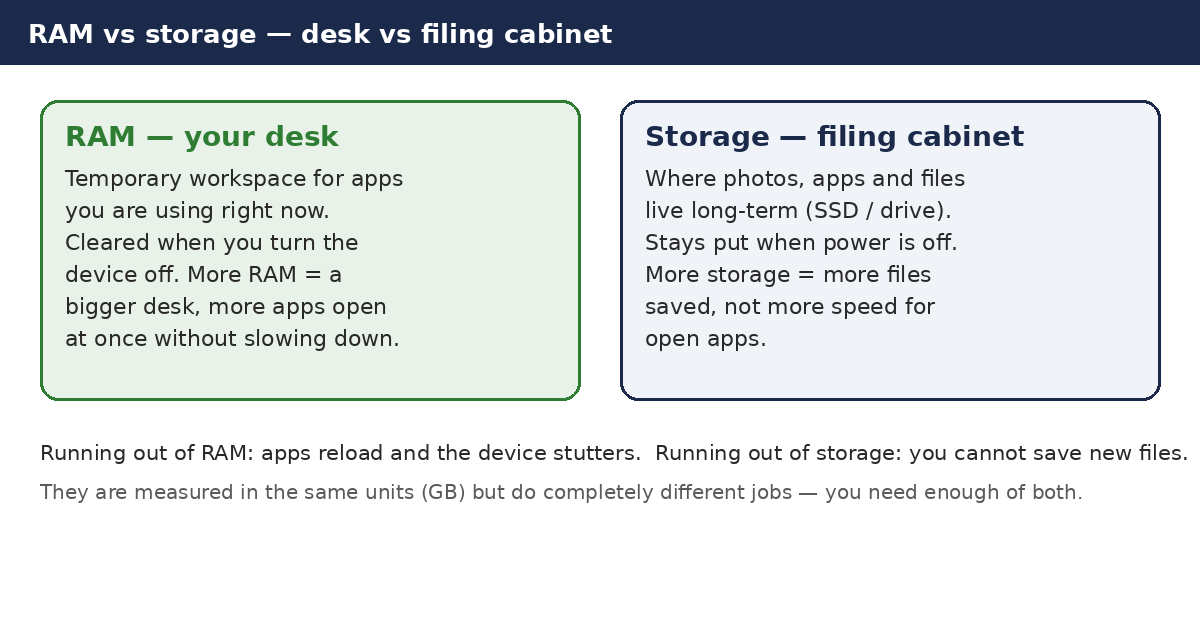
RAM is your device's short-term workspace. It holds the apps and data you are using right now so the processor can reach them almost instantly. When people say a phone or laptop feels slow because it "needs more memory," this is usually the memory they mean — not the storage where your photos live.
Diagram: Stack and Value (original)
What it is
RAM stands for Random Access Memory. Think of it as a desk: the bigger the desk, the more you can have open at once. Storage — an SSD in a laptop or the built-in storage in a phone — is the filing cabinet. It keeps everything when the power is off. RAM is cleared when you shut down or restart, which is why a restart often fixes a sluggish device: it empties the desk.
Both are measured in gigabytes (GB), which causes most of the confusion. A laptop listed as "16GB / 512GB" has 16GB of RAM and 512GB of storage. Adding storage will not stop apps reloading, and adding RAM will not give you room for more photos.
When RAM fills up, background apps get pushed out to make room. On a phone, you see apps reloading when you switch back to them. On a laptop, it shows up as stutter when you jump between tabs, documents, and a video call.
DDR4 vs DDR5
On laptops and desktops you will also see DDR4 or DDR5 — DDR is the generation of the RAM itself. DDR5 is the current standard on new machines: it moves more data per second than DDR4 and uses slightly less power. DDR4 is the older generation, still common in budget laptops and older machines.
The two are not interchangeable — a laptop built for one cannot use the other, and many thin laptops have RAM soldered in place so it cannot be changed at all. For everyday browsing, documents, and streaming, the generation matters far less than having enough gigabytes. Capacity first, generation second. Phones use a low-power cousin called LPDDR, currently LPDDR5 or LPDDR5X in most new models, and the same rule applies.
How much you actually need
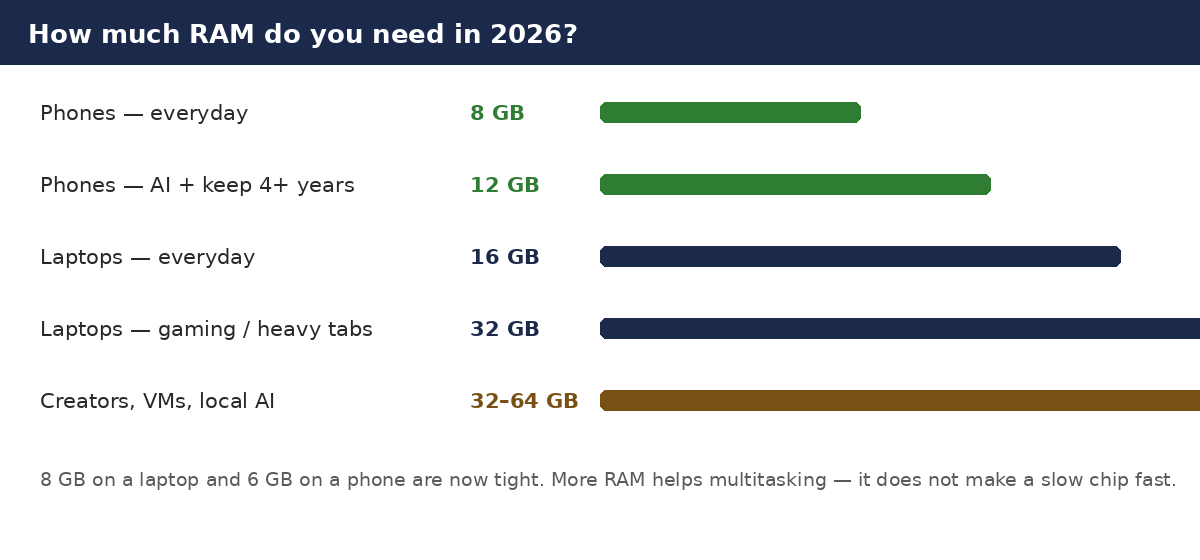
Diagram: Stack and Value (original)
Phones. For most people in 2026, 8GB is enough for messaging, browsing, streaming, photos, and moderate gaming. Aim for 12GB if you want the newest on-device AI features, play demanding games while switching apps, or plan to keep the phone for four years or more — several current AI features set 12GB as a minimum, alongside a supported chip. 16GB and above is mainly for gaming phones. iPhones manage memory differently and generally do more with less, so compare RAM within Android or within iPhone, not across the two.
Laptops. Treat 16GB as the sensible minimum in 2026. It handles many browser tabs, office apps, and a video call at once, and it is the baseline Apple now ships on new Macs and Microsoft requires for Copilot+ PCs. 8GB laptops still exist at low prices, but they feel tight quickly. Choose 32GB if you game, edit photos or video, keep many heavy apps open, or want the machine to stay comfortable for years.
Gaming and creating. For gaming, 32GB is the comfortable target — modern games plus a browser, chat, and recording tools add up fast. Video editors, people running virtual machines, and anyone running AI models locally should treat 32GB as a floor and 64GB if the work is serious.
Why it matters
RAM does not make a slow processor fast, and more RAM than you need does not speed anything up. What it does is stop the slowdowns that happen when you run out: reloads, stutter, and apps closing in the background. The right question is not "what is the fastest RAM?" but "what covers how I actually use this device, with a little headroom for next year?"
Bottom line
RAM is temporary workspace, storage is long-term keeping, and you need enough of both. In 2026 that means 8GB on a phone for most people (12GB for AI features and long ownership), 16GB on a laptop as the baseline, and 32GB for gaming and heavier work. If a spec sheet forces a choice, spend on enough RAM before you spend on a faster variant of it.

Member discussion