
What Is Qi2? Magnetic Wireless Charging Explained (2026)
Qi2 is wireless charging with magnets that snap your phone into perfect alignment. Here is how 15W and 25W differ, what Qi2 Ready really means, and which phones support it.

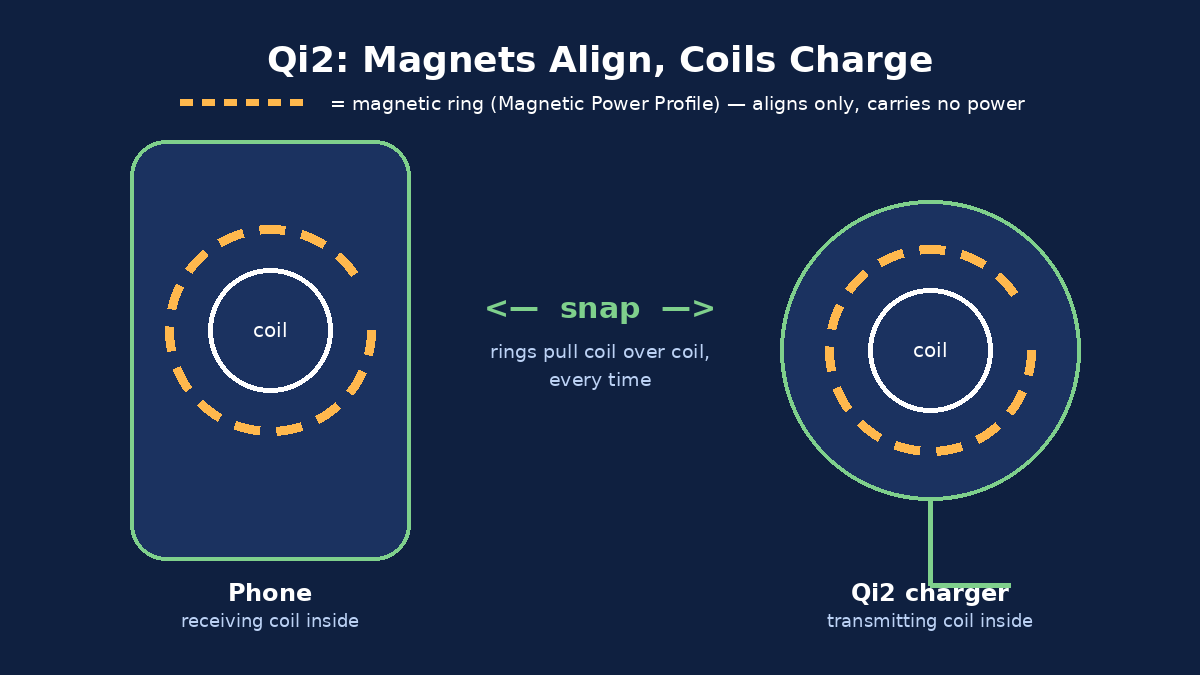
Wireless charging used to mean setting your phone on a flat pad and hoping you placed it in exactly the right spot. Qi2 fixes that with magnets: the phone snaps into alignment on its own. Here is what the name means and how to tell whether your phone supports it.
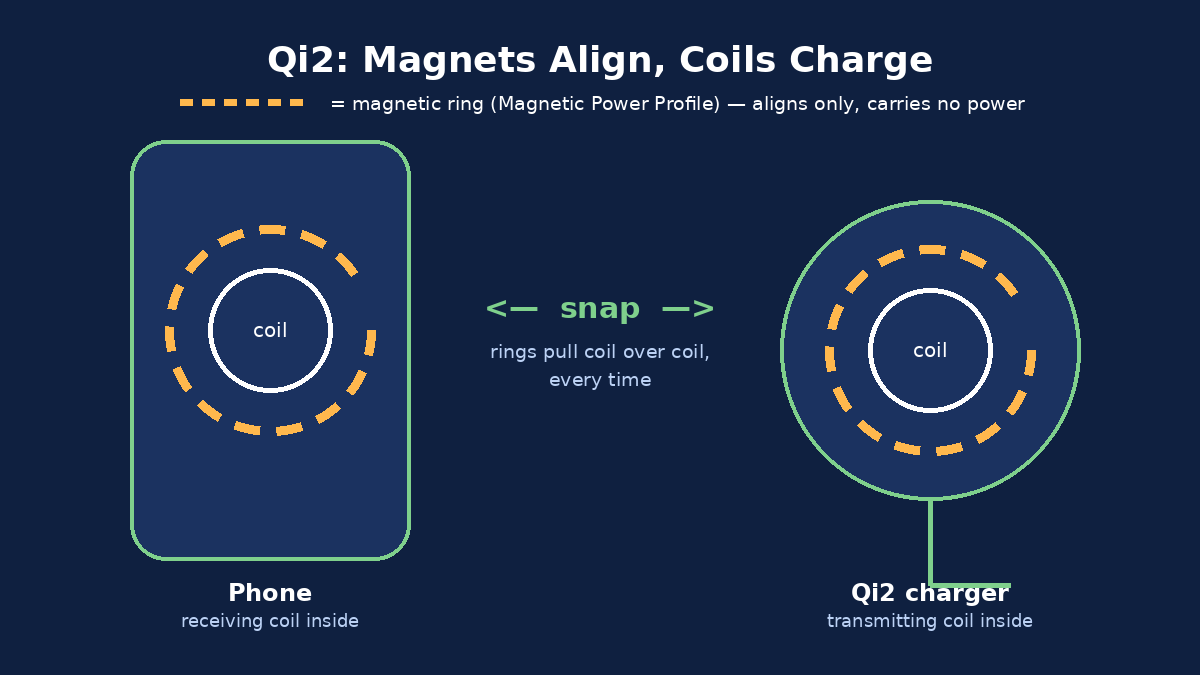
Diagram: Stack and Value. The magnetic ring lines the two coils up; the coils do the charging.
What it is
Qi (pronounced "chee") is the wireless charging standard maintained by the Wireless Power Consortium (WPC), an industry group whose members include Apple, Google, and Samsung. Qi2 is its second generation, launched in 2023.
The headline addition is the Magnetic Power Profile: a standardized ring of magnets in both the phone and the charger. The magnets carry no power at all — a coil in the charger creates a magnetic field, and a coil in the phone turns it back into electricity, as with any wireless charger. The ring's only job is alignment, pulling the two coils directly over each other so less energy is wasted as heat.
That idea came from Apple. MagSafe, introduced with the iPhone 12 in 2020, proved magnetic alignment worked, and Apple contributed its magnetic technology to the WPC as the basis for Qi2. The difference is ownership: MagSafe is Apple's own system for iPhones, while Qi2 is an open standard any brand can certify against. Original Qi had no magnets, so a phone placed slightly off-center could charge slowly or stop altogether.
Why it matters
Speed is the visible gain. The first Qi2 tier charges at up to 15W. A newer tier, Qi2 25W — the branding for Qi version 2.2, launched in July 2025 — raises that to 25W, which the WPC says can take a phone from 0 to 50% in about 30 minutes. Both tiers use the same ring; 25W simply allows more power through it.
The standardized ring also means certified phones and chargers from different brands snap together the same way, producing a shared ecosystem of stands, car mounts, wallets, and battery packs. Support in 2026:
- iPhone 12 and later have built-in magnets and charge at up to 15W on Qi2; the iPhone 16 and 17 series reach 25W on Qi2 25W chargers (the slim iPhone Air caps at 20W). The budget iPhone 16e is the exception — no magnets, basic Qi only.
- Google Pixel 10 series phones have built-in magnets (Google calls it Pixelsnap). The Pixel 10 Pro XL reaches 25W; the other models cap at 15W.
- Samsung Galaxy S25 and S26 series phones are "Qi2 Ready" rather than full Qi2 — see below. With a magnetic case, the S26 Ultra can reach 25W; the S25 series tops out at 15W.
Everything is backward compatible: a Qi2 25W charger charges an older phone safely, just at that phone's own maximum.
What to look for / how to use it
Check the logo, not the magnet. Only products that pass WPC certification can carry the Qi2 or Qi2 25W logo, and certified products are listed in the WPC's public database. A charger can have a magnetic ring and still be uncertified, with no guaranteed speed or safety. Watch out for "MagSafe-compatible," which usually means an uncertified charger that charges an iPhone at a slow 7.5W.
Understand "Qi2 Ready." A Qi2 Ready phone supports Qi2 charging internally but has no built-in magnets — they live in a case instead. A Galaxy S25 or S26 used bare will not snap onto a Qi2 charger; add an approved magnetic case and it gets the full alignment and speed. The reverse does not work: a magnetic case on a phone with no Qi2 support adds attachment only, not speed.
Match the whole chain. Getting 25W takes a supporting phone, a Qi2 25W–certified charger, and a USB-C wall adapter powerful enough to feed it — generally 30W or higher. If any link tops out lower, charging drops to that level. Thick or metal cases can also weaken the magnetic hold.
Bottom line
Qi2 is wireless charging with the guesswork removed: an open standard, built on magnetic alignment, at 15W — or 25W on the newest phones and chargers. Before buying anything, confirm whether your phone is Qi2, Qi2 Ready, or neither, and look for the certified Qi2 logo on the charger.
Member discussion