
What Is HDMI 2.1? 4K 120Hz, eARC and VRR Explained (2026)
HDMI 2.1 means 48 Gbps, 4K at 120Hz, eARC and VRR — but not every port labelled 2.1 delivers all of it. Here is what the number actually guarantees, and what it does not.

Your TV says "HDMI 2.1" on the box, your console says it too — but what does that number actually buy you? HDMI 2.1 is less about the plug (it looks identical) and more about how much picture and sound the connection can carry, and which gaming and audio features it can switch on.
What HDMI 2.1 is
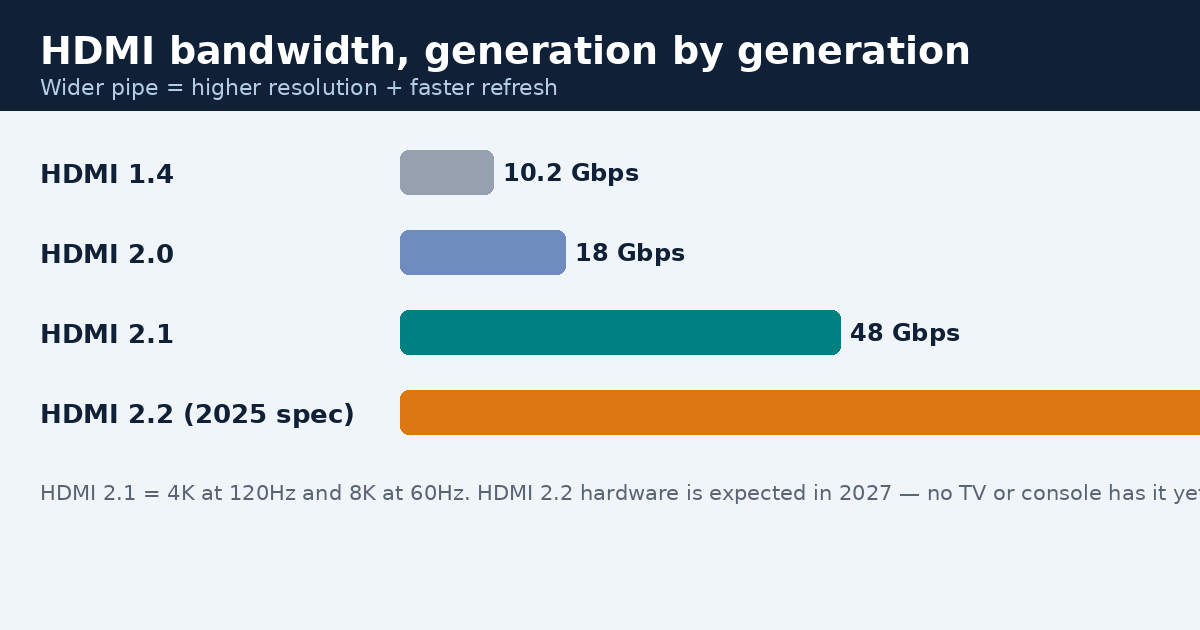
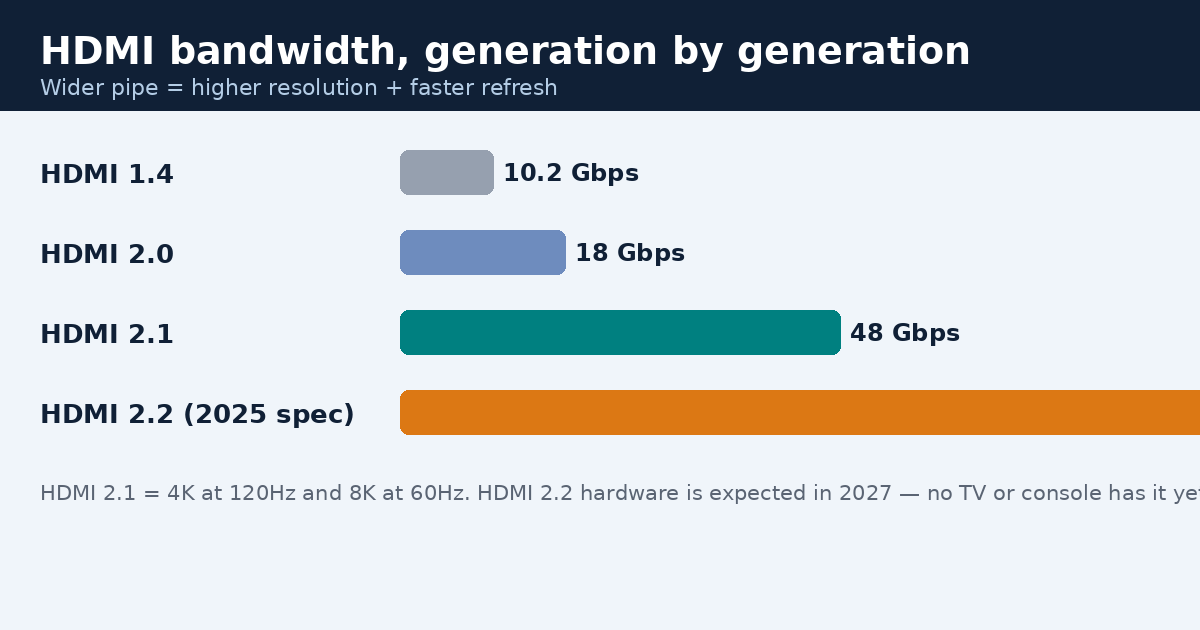
HDMI 2.1 is a version of the HDMI standard, released in 2017 and standard on TVs, consoles, and soundbars since about 2020. Its headline upgrade is bandwidth: up to 48 Gbps, compared with 18 Gbps for HDMI 2.0. That wider pipe is what makes everything else on this page possible.
The connector did not change, and HDMI 2.1 is fully backwards compatible — an HDMI 2.1 cable works in an older port, just at the older port's speed.
What the extra bandwidth unlocks
- 4K at 120Hz — the mode the PlayStation 5 and Xbox Series X are built around. HDMI 2.0 tops out at 4K 60Hz.
- 8K at 60Hz — supported by the standard, even though 8K TVs and content remain rare.
- Dynamic HDR — brightness and colour can be adjusted scene by scene (or frame by frame) instead of once for a whole film.
- eARC (enhanced Audio Return Channel) — sends full-quality sound from the TV back to a soundbar or receiver over the same cable, including lossless Dolby TrueHD and object-based Dolby Atmos and DTS:X. The older ARC is limited to compressed formats.
The gaming features: VRR, ALLM, QFT, QMS
Four abbreviations do most of the real-world work for gamers:
- VRR (Variable Refresh Rate) — the TV changes its refresh rate to match the game's frame rate moment by moment, which reduces screen tearing and stutter.
- ALLM (Auto Low Latency Mode) — the TV spots a console and switches itself into its low-lag game mode automatically.
- QFT (Quick Frame Transport) — shaves a little more latency by moving each frame to the display faster.
- QMS (Quick Media Switching) — removes the brief black screen when a player switches between, say, 24Hz film and 60Hz menus.
The catches worth knowing
Not every "HDMI 2.1" port is full speed. The standard allows ports well below 48 Gbps, and many TVs offer full bandwidth on only some of their ports — often the ones labelled "4K 120" or with the eARC port doubling as one of them. Features like VRR and eARC are also technically optional, and a few can even appear on late HDMI 2.0 hardware. Read the port labels and the spec sheet, not just the version number.
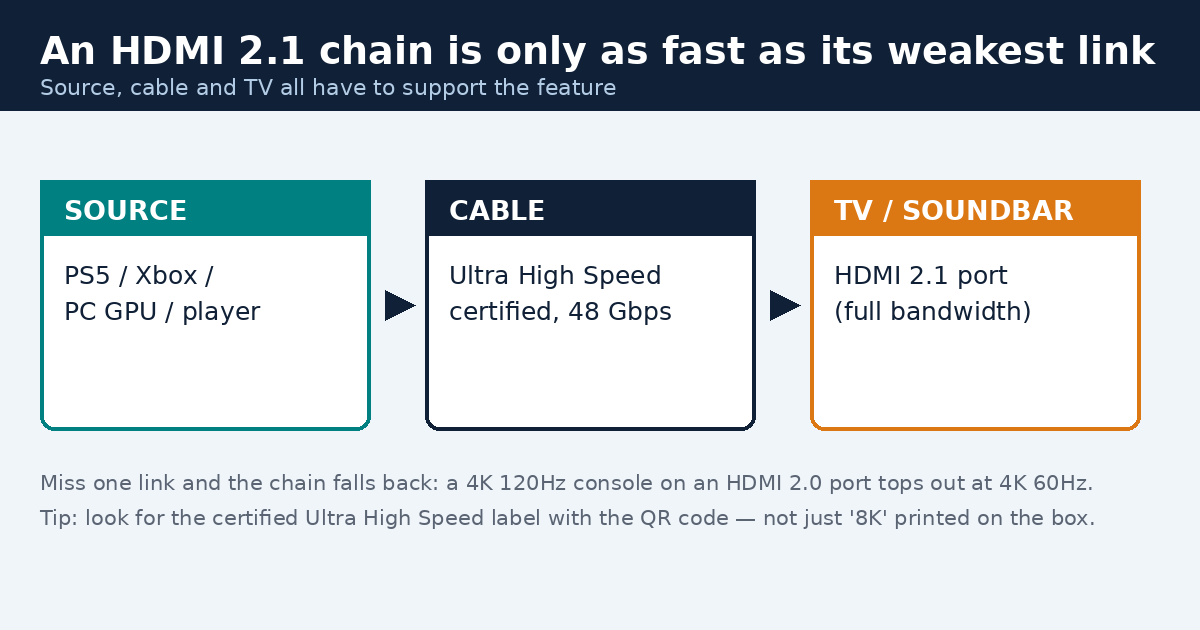
The cable matters, and it has a proper name. For full HDMI 2.1 bandwidth you need a cable certified as Ultra High Speed HDMI — look for that exact name and the certification label with a QR code you can scan in the HDMI Cable Certification app. A cable that just says "8K" or "HDMI 2.1" in big print, without the certification label, is making an unverified claim.
Your chain is only as fast as its weakest link. Console, cable, any soundbar or receiver in between, and TV all have to support a feature for it to work. Plug a 4K 120Hz console into a soundbar with HDMI 2.0 passthrough and you will get 4K 60Hz, however good the TV is. The usual fix is to plug the console straight into the TV and let eARC carry the sound back to the soundbar.
What about HDMI 2.2?
HDMI 2.2 was formally released on June 25, 2025. It doubles the ceiling again to 96 Gbps using cables certified under the new Ultra96 name, and the first certified Ultra96 cables went on sale in September 2026. But no TV, console, or graphics card on sale today has an HDMI 2.2 port — the first HDMI 2.2 products are expected in 2027. An Ultra96 cable works fine in today's ports at HDMI 2.1 speed, so it only really makes sense for a cable you are burying in a wall and never want to replace.
Do you need HDMI 2.1?
- Yes, if you game on a PS5, Xbox Series X, or a gaming PC and your TV supports 120Hz — it is the only way to get 4K 120Hz, VRR, and ALLM together.
- Yes, if you use a soundbar or receiver for Atmos — eARC is the clean one-cable route to lossless audio from TV apps and connected players.
- Probably not, if you only stream films and TV at 4K 60Hz or below — HDMI 2.0 already handles that, and your money is better spent on the panel itself.
Bottom line
HDMI 2.1 means a 48 Gbps connection with 4K 120Hz, eARC, VRR, and ALLM on the table — but the version number alone guarantees none of them. Check that the specific ports are full-bandwidth, buy a certified Ultra High Speed cable, and keep every device in the chain up to the same standard.

Member discussion