
What Is an NPU? The AI Chip in Your Phone and Laptop, Explained (2026)
An NPU is the low-power AI chip inside your phone and laptop. Here is what it does, what TOPS means, and when the number actually matters.

An NPU is the part of your phone or laptop chip built just for AI tasks. It is why your phone can clean up a photo, translate a conversation, or add live captions without sending everything to the cloud.
Diagram: Stack and Value (original)
What it is
NPU stands for Neural Processing Unit. It is not usually a separate chip. It is a section inside the main processor, alongside the CPU and GPU, designed for one kind of maths: the large batches of small, repetitive calculations that neural networks run on.
Every maker gives it a different name. Apple calls its version the Neural Engine, Qualcomm calls its version the Hexagon NPU, and AMD calls its version XDNA. The job is the same: run AI work — called inference, meaning using a trained model, not training one — quickly and with very little power.
That low power is the point. A CPU or GPU can run the same task, but usually uses far more battery. An NPU can keep small jobs running in the background — a wake word, photo sorting — without waking the whole chip.
NPU vs CPU vs GPU
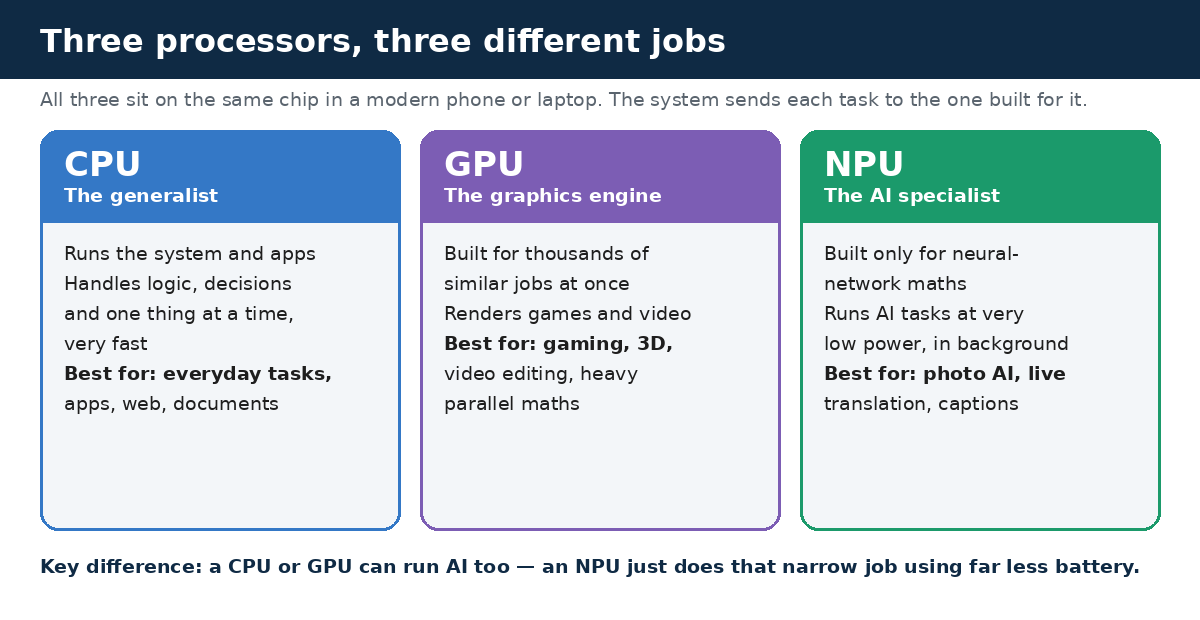
Think of them as different workers. The CPU is the generalist: a few fast cores that run the system, open apps, and handle decisions one step at a time. The GPU is built for thousands of similar jobs at once, which suits graphics, gaming, and video — and a lot of AI maths too. The NPU is the narrow specialist: it does less, but does neural-network work more efficiently than both.
None replaces the others. Gaming still belongs to the GPU, everyday speed to the CPU, and heavy AI training to large servers. The NPU handles the steady, lightweight AI work in between.
What TOPS means
NPU speed is quoted in TOPS: trillions of operations per second. A 45 TOPS NPU can, in theory, do up to 45 trillion of those small AI operations every second.
Treat that number with care. TOPS is a peak, not a promise. Makers usually measure it at a low precision called INT8, under ideal conditions, and not in the same way. Some quote the NPU alone; others advertise a bigger combined CPU + GPU + NPU total — Intel quoted 120 total TOPS for Lunar Lake, of which 48 came from the NPU. Real speed also depends on memory bandwidth and whether the app uses the NPU at all.
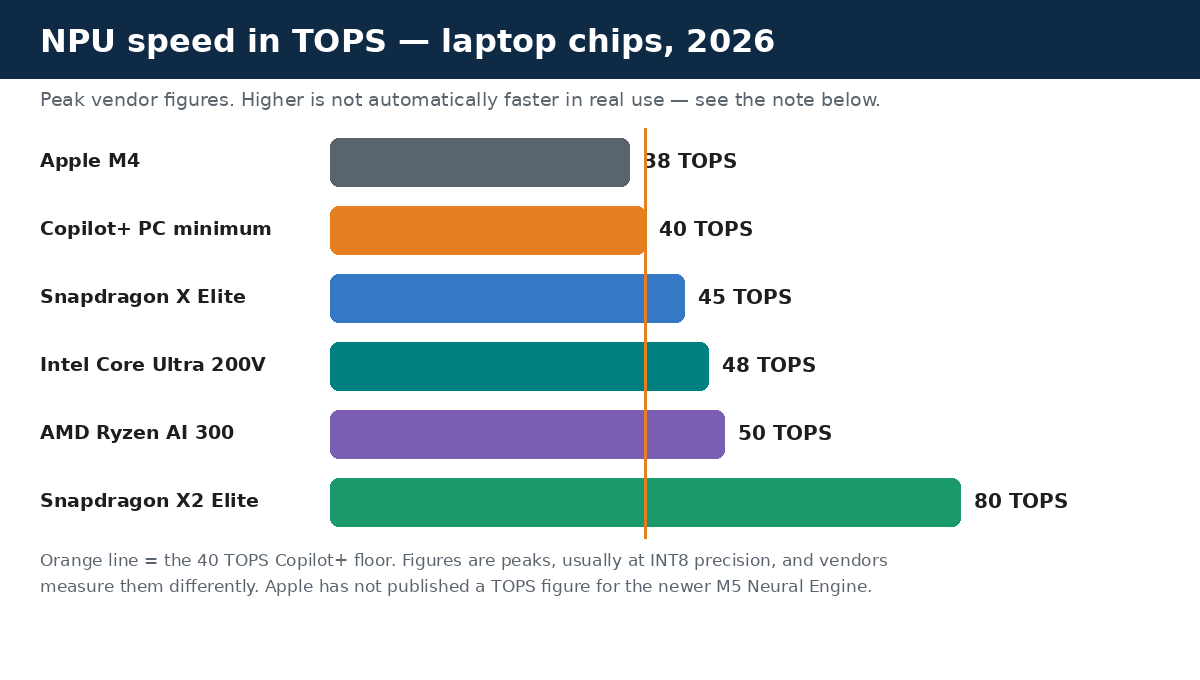
Diagram: Stack and Value (original)
What it actually does in 2026
On phones, the NPU handles much of the everyday AI you already use: cleaning up low-light photos, removing objects from pictures, live translation and captions, transcribing voice notes, and summarising messages. Apple Intelligence runs many writing tools, notification summaries, and photo features on the device, sending larger requests to its Private Cloud Compute servers. Samsung's Galaxy AI does a similar split — Live Translate can run on the device, while some editing uses the cloud. Google's Gemini Nano runs smaller tasks on supported Pixel phones, including scam-call detection.
On Windows laptops, the clearest use is Microsoft's Copilot+ features: Live Captions with translation, Windows Studio Effects such as background blur on video calls, improved search, and image tools such as Cocreator. Those features require a qualifying NPU. The big chatbot in your browser is different — ChatGPT, Gemini, and similar web tools run on remote servers, so a faster NPU makes no difference to them.
How much you need
For a Windows laptop, one number has real meaning: 40 TOPS. Microsoft requires an NPU rated at 40 TOPS or more, plus 16GB of RAM and a 256GB SSD, for a Copilot+ PC. Chips that clear it include Snapdragon X Elite at 45 TOPS, Intel's Core Ultra 200V (Lunar Lake) at up to 48 TOPS, and AMD's Ryzen AI 300 at up to 50 TOPS. The newer Snapdragon X2 Elite, announced in September 2025 for 2026 laptops, is rated at 80 TOPS. Apple's M4 is rated at 38 TOPS — just under that Windows line, which does not apply to Macs anyway.
For a phone, do not shop by TOPS. Check that the exact model supports the AI features you want, in your language and region, with enough RAM for them. If you mainly browse, message, and stream, the NPU should not decide your purchase.
Bottom line
An NPU is a low-power AI specialist sitting next to the CPU and GPU. It matters most for on-device photo, translation, caption, and video-call features, and, on Windows, for clearing the 40 TOPS Copilot+ bar. Beyond that bar, a bigger TOPS number is a weak reason to pay more — RAM, software support, and battery life will affect your day far more.

Member discussion